


The Shift from Plywood to Sheet Metal Is Reshaping Kitchen Pull-Out Baskets
Nov 04, 2026
Leave a message
The change started on the factory floor
What makes this transition interesting is that it did not begin as a marketing story. It began with equipment.
Sheet-metal baskets used to be expensive to develop. A single set of stamping tooling could run into six figures in RMB, which meant only a handful of high-volume shapes made commercial sense. As laser tube-cutting and laser sheet-cutting became widely available, that barrier largely disappeared. Frames can now be cut and adjusted without committing to a full die set, so new sizes, new profiles and cabinet-specific variants reach production far faster than before.
When the market was comfortable, few manufacturers felt any pressure to change. Stronger competition altered that. Iteration cycles shortened, and the industry began reworking both styles and configurations at a pace it had not sustained in years.
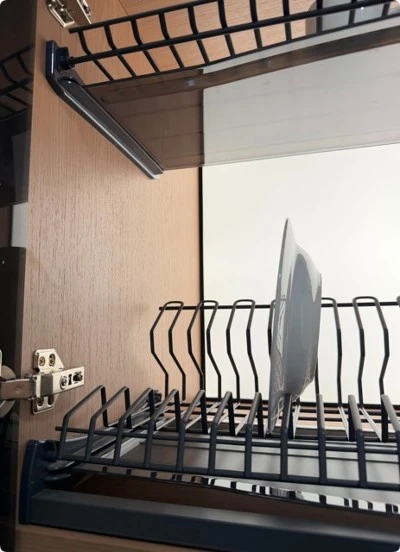
Why the product itself wins
Cost and flexibility explain the supply side. On the demand side, the case is more straightforward.
Plywood is, in the end, plywood. In a kitchen environment - humidity, heat, repeated loading - laminated layers eventually peel and delaminate. A sheet-metal basket does not have that failure mode. It lasts longer, carries load better, and, somewhat counterintuitively, now sells at a lower price point than the wooden construction it replaces.
Better performance at a lower price is an unusual combination. It rarely stays a niche for long.
The market has already signalled where it is going
Two signals are worth reading together. Leading European basket brands have gradually given their core catalogue and homepage space to sheet-metal ranges. At the same time, overseas buyers who had purchased plywood baskets for years have responded positively once shown a full sheet-metal lineup, with strong intent to place orders.
For distributors and private-label brands, this is the part that matters. A category transition is one of the few windows in which a range can be launched before the shelf gets crowded. Moving early means helping define that shelf; arriving after the shift mostly means competing on price. As one partner put it during a recent review: if the product is right and it is not on the market yet, why not take the first share?
Four series, one complete lineup
We completed four basket series this year, deliberately built to be presented as a range rather than as isolated items. A complete family consistently draws more interest from buyers than a single model, because it lets them assemble a coherent assortment across price tiers and cabinet types in one conversation.
| Series | Construction | Best fit |
|---|---|---|
| All Sheet-Metal | Full sheet-metal body for wall, corner, base and tall cabinets | Flagship range with full-scene coverage |
| Removable Plastic Base | Plastic bottom panel lifts out for washing and clips back on | Markets where easy cleaning is a selling point |
| Flat-Iron Frame + Sheet-Metal Base | Durable metal base with a flat-iron frame | Price-sensitive programmes that still want a metal base |
| All Flat-Iron | Flat iron combined with machine-formed wire | Entry-level, best-value option |
The logic is coverage, not variety for its own sake. A buyer can specify a premium tall-unit solution and an entry-level base-cabinet option from the same supplier, under one consistent design language and one set of quality standards.
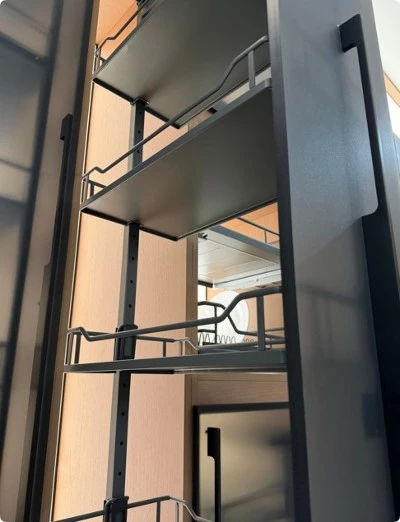
Finish is a sourcing decision, not just a look
Surface treatment is where avoidable cost and mismatch tend to hide, so it pays to be precise.
Electroplating and powder coating sit in the same cost tier. With copper prices rising this year, the two can now be quoted at broadly comparable levels - giving buyers real freedom to choose on finish and target market rather than on price alone.
Dip coating is used mostly for dish racks and is generally not applied to base-cabinet baskets.
Nano dry-plating is well received in China and Southeast Asia, while overseas markets tend to prefer conventional finishes.
One detail is easy to overlook: dip coating is priced by weight, and its unit cost falls as the part gets heavier, because the hanging, drying and handling steps are fixed for each line run. Small, light parts therefore carry a disproportionately higher finishing cost. Understanding that structure is how we help partners choose a finish that fits both the product and the budget - before it shows up in a quotation.
What we would suggest to partners
The practical recommendation is a simple one: review your basket range now, while the transition is still underway. We prefer to work backwards from a market's requirements rather than forwards from a catalogue, starting with what your customers actually need and then developing the matching configuration with our product team. For partners willing to introduce new models early, that is where the head start is.
If you would like the full four-series catalogue, the available finish options, or samples for evaluation, our team is ready to put a proposal together.